Halogen vs bi-xenon vs bi-LED: lighting technology compared
Halogen, bi-xenon and bi-LED headlights tested side by side, with lux readings for low and high beam and photos of each beam.
On this page
In our side-by-side tests, upgraded projectors gave by far the most light. Our integrated bi-LED read 4,660 lux on low beam and the G5-BRT bi-xenon 4,210 lux, against 200 lux for halogen. Peak brightness isn't the whole story, though: the width and depth of the beam matter just as much.
We tested every lighting technology we fit, side by side. Here are the readings and photos of each beam.
Halogen, bi-xenon and bi-LED: the difference
- Halogen: a filament bulb in a reflector bowl. The oldest and dimmest of the three.
- Bi-xenon: a gas-discharge (HID) bulb driven by a ballast, in a projector that gives both low and high beam.
- Bi-LED: LEDs in a projector that gives both low and high beam.
Headlights and parts used
- Halogen: E90 pre-LCI halogen, with the front plastic lens removed
- Bi-xenon: E92 pre-LCI bi-xenon standalone projector
- Bi-xenon (upgraded projector lens): E92 pre-LCI bi-xenon standalone projector with a ZKW-R lens upgrade
- Bi-xenon (upgraded projector): G5-BRT bi-xenon projector
- Bi-LED: KYCS bi-LED projector with an LED bulb (low beam), and a high beam LED array paired with the low beam projector shutter
- OEM bi-LED: F22 LCI bi-LED projector
- Upgraded bi-LED: KYCS integrated bi-LED
All the bi-xenon projectors used the same second-hand bulb. Expect much more light from a new set of quality bulbs, such as Osram Night Breaker Laser.
Lux comparison
Lux measures brightness: lumens per square metre. We don't have laboratory measuring equipment, so treat every figure as an approximation, rounded to the nearest ten.
Each reading is taken from the centre hotspot, which isn't the whole picture. The size of the beam pattern, its width and depth, matters just as much to how much usable light you have. For example, our bi-LED setup has a much wider and deeper beam pattern but a lower peak brightness than a comparable xenon setup, which has a smaller beam pattern and a higher peak.
| Headlight | Low beam (lux) | Low and high beam (lux) |
|---|---|---|
| Halogen | 200 | 420 |
| Bi-xenon | 1,500 | 3,300 |
| Bi-xenon (upgraded projector lens) | 2,020 | 3,900 |
| Bi-xenon (upgraded projector) | 4,210 | 8,320 |
| Bi-LED | 860 | 6,280 |
| OEM bi-LED | 1,580 | 5,160 |
| Upgraded bi-LED | 4,660 | 5,940 |
What the results show
- An upgraded projector is the biggest single gain. The G5-BRT nearly tripled the standard bi-xenon's low beam reading.
- A ZKW-R lens upgrade alone lifted the standard bi-xenon's low beam from 1,500 to 2,020 lux.
- The OEM bi-LED and the standard bi-xenon read almost the same on low beam.
- Halogen trailed every other setup by a wide margin.
Photos
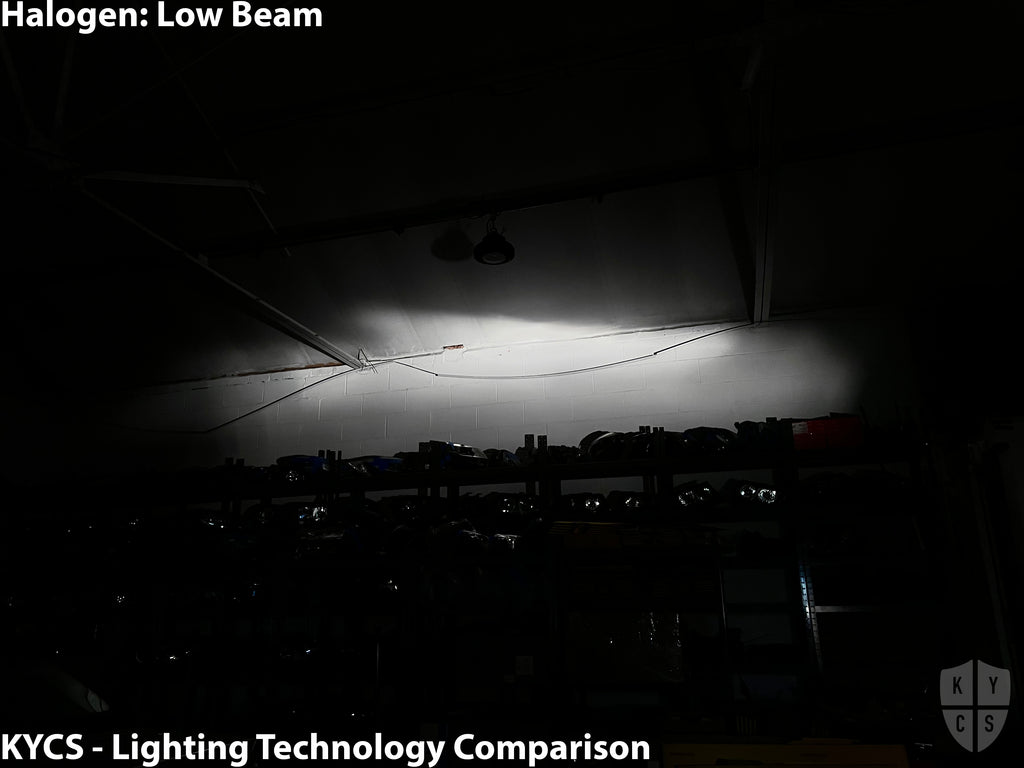
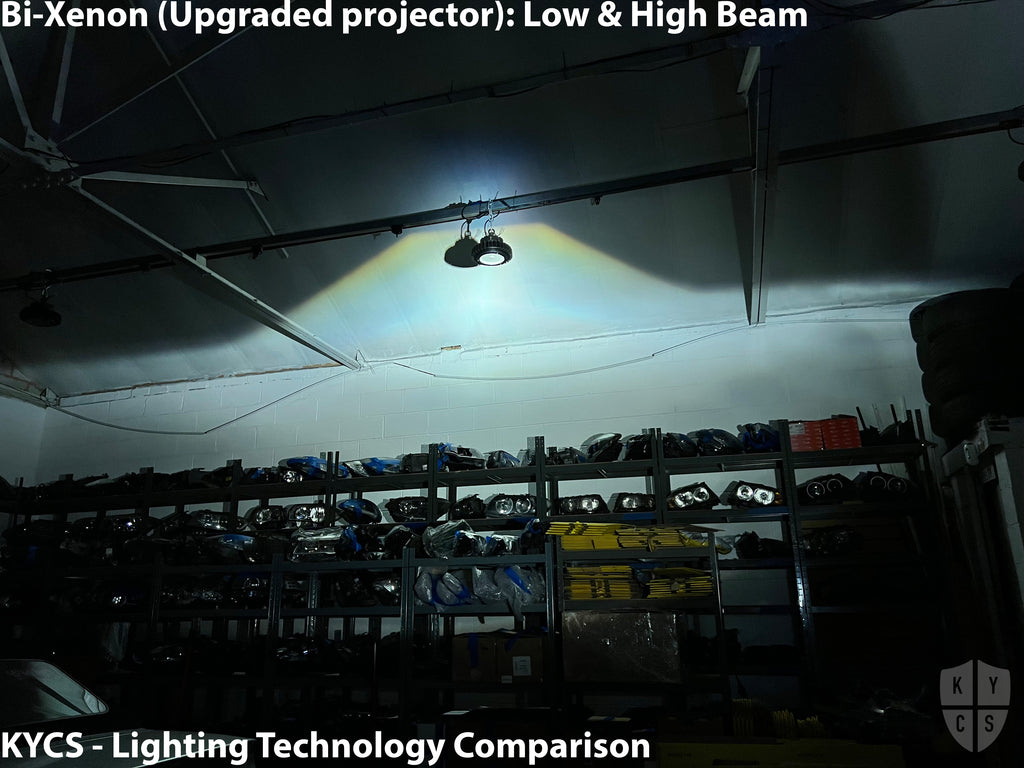
The photos were taken on an iPhone with exposure and focus locked. The white balance varies between photos, but the brightness is accurate.




Common questions
Which headlight technology is brightest?
In our tests, upgraded projectors. Our integrated bi-LED gave the highest low beam reading, 4,660 lux. The G5-BRT bi-xenon gave the highest low and high beam reading, 8,320 lux.
Is LED brighter than xenon?
Not always. The OEM bi-LED and the standard bi-xenon read almost the same on low beam, 1,580 and 1,500 lux. Our bi-LED setup has a lower peak than a comparable xenon setup but a much wider and deeper beam.
How much brighter is bi-xenon than halogen?
On low beam, the standard bi-xenon read 1,500 lux against 200 lux for halogen, seven and a half times as bright at the centre hotspot.
What is lux?
A measure of brightness: lumens per square metre. Our readings are from the centre hotspot of each beam, so they show peak brightness, not beam width or depth.
Do new bulbs make a difference?
Yes. All our bi-xenon tests used the same second-hand bulb. Expect much more light from a new set of quality bulbs, such as Osram Night Breaker Laser.
How accurate are these figures?
Treat them as approximations. We don't use laboratory equipment, and every reading is rounded to the nearest ten.
Choosing for your build
Need a hand deciding what goes in your custom headlights? Choose your vehicle to start, or WhatsApp us on 0121 295 1900.